Category: Computer Programming

How to delete a directory in Linux
To delete a directory in Linux in a desktop environment is easy as pressing the Del / Delete key. To delete a directory in Linux using command line CLI in Terminal or SSH you can use the rm command. The bellow works fine for a file. A directory cannot be removed just like that. The…
How to exit VIM – VI Editor
How to exit VIM or VI editor. VIM stands for Vi IMproved. As in a better editor than VI. You can start Vim at any terminal or in a SSH session on Linux with this command: Same goes for vi commands, opens a file the same way. Once vim / vi is opened you are…
Linux commands cheat sheet the most used list
Most useful Linux commands for daily # Display how long has the system been running – since tle last restart. # List directory contents # List files in directory but better attributes and human-readable # List files in directory sorted by file date/time. # Change directory # Wildcards When filtering for files or directories you…
How to learn Python as a second language
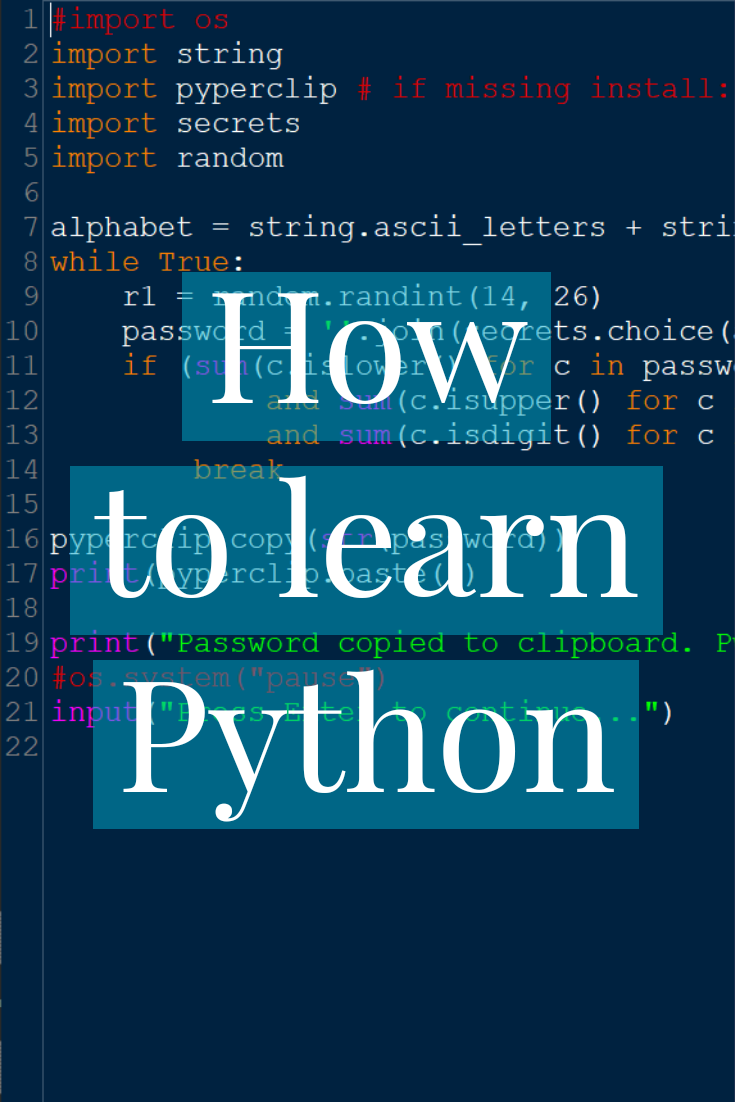
How to learn Python as a second language. After watching and reading few tutorials you still can’t say that you know much Python and that’s probably true. How I try to learn it, still work in progress, is to use a project-based approach. Learn the basics of the language. 1. No semicolons; 2. Indentation matters…
Random Password generator in Python
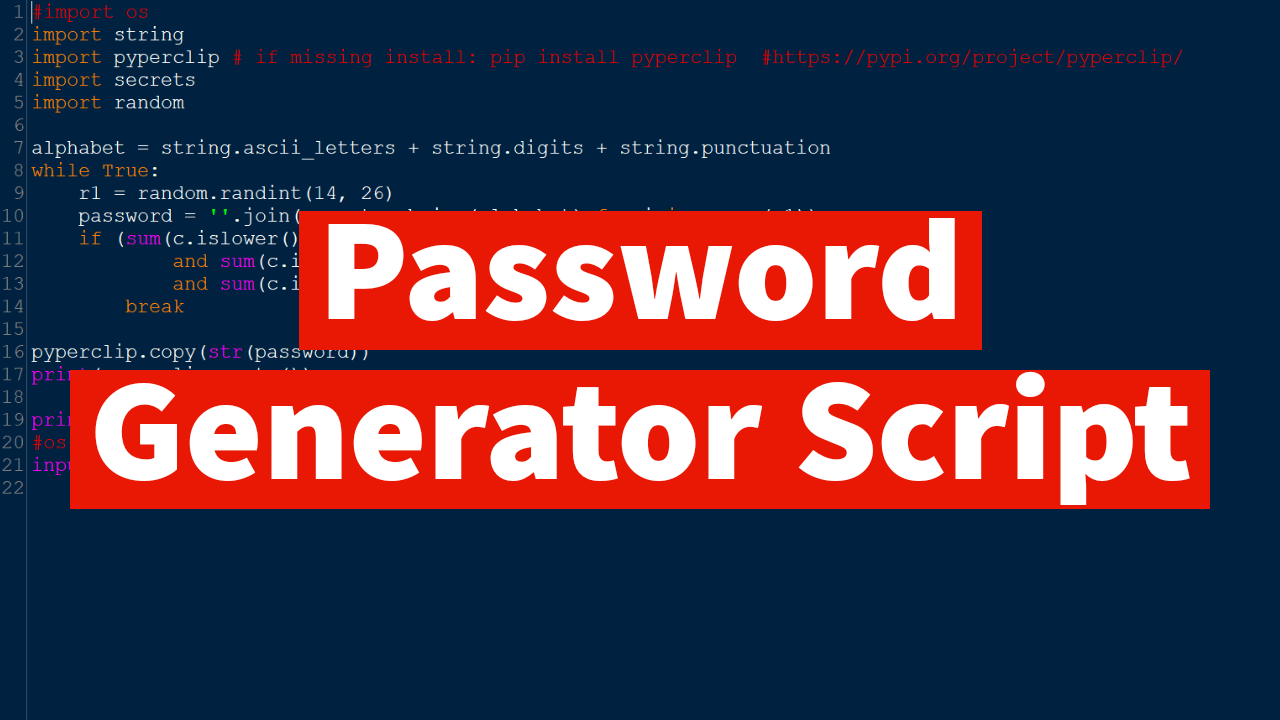
Random Password generator in Python How I wrote a random secure password generator in Python in 30 min. What I needed was a small script that I execute and generate a random password that is then copied to the clipboard and all I had to do was paste it Ctrl+V to use it. Every time…
155. Min Stack
155. Min Stack Solution programming interview question. Design a stack that can return the minimum element in constant time and also support pus, pop and top methods. Example:Input[“MinStack”,”push: -3″,”push: 0″,”push: -5″,”getMin”,”pop”,”top”,”getMin”] OutputMinStack minStack = new MinStack();minStack.push(-3); // returns nullminStack.push(0); // returns nullminStack.push(-5); // returns nullminStack.getMin(); // return -5minStack.pop(); // returns nullminStack.top(); // return 0minStack.getMin(); //…
20. Valid Parentheses Leetcode Solution
Valid Parentheses Leetcode 20 Solution Return boolean indicating wether the pairs of paranthesis are matching and there are no un-matched paranthesis found. Using a list to implement a stack in Python.Store all the pairs of opening and closing tags in a dictionary. Closing brackets are the key.Go thru the characters of the string and add…
66. Plus One LeetCode Solution in Python
Plus One LeetCode Solution in Python 3. Given a non empty array of decimal digits representing a non-begative integer.Increment the integer, most significant digit is on the left. Each element contains a single digit.No leading zeros except for the number 0. Examples Input: digits = [1,2,3] Output: [1,2,4] Input array represents the int 123 +…
Google Interview 686. Repeated String Match
Google Interview 686. Repeated String Match. Given two strings a and b, return the minimum number of times you should repeat string a so that string b becomes a subscring of sring a.If b cannot be a substring of a after repeating it, return -1. String “acb” repeated 0 times is “”, repeated 1 times…
Google 844. Backspace String Compare
Google Interview 844. Backspace String Compare Given two strings s and t, return True if they are equal. ‘#’ means backspace. Examples Input: s = “ab#c”, t = “ad#c” Output: true Explanation: Both s and t become “ac”. Input: s = “abb#c”, t = “ade#c” Output: false Explanation: s becomes “abc” and t becomes “adc”.…