


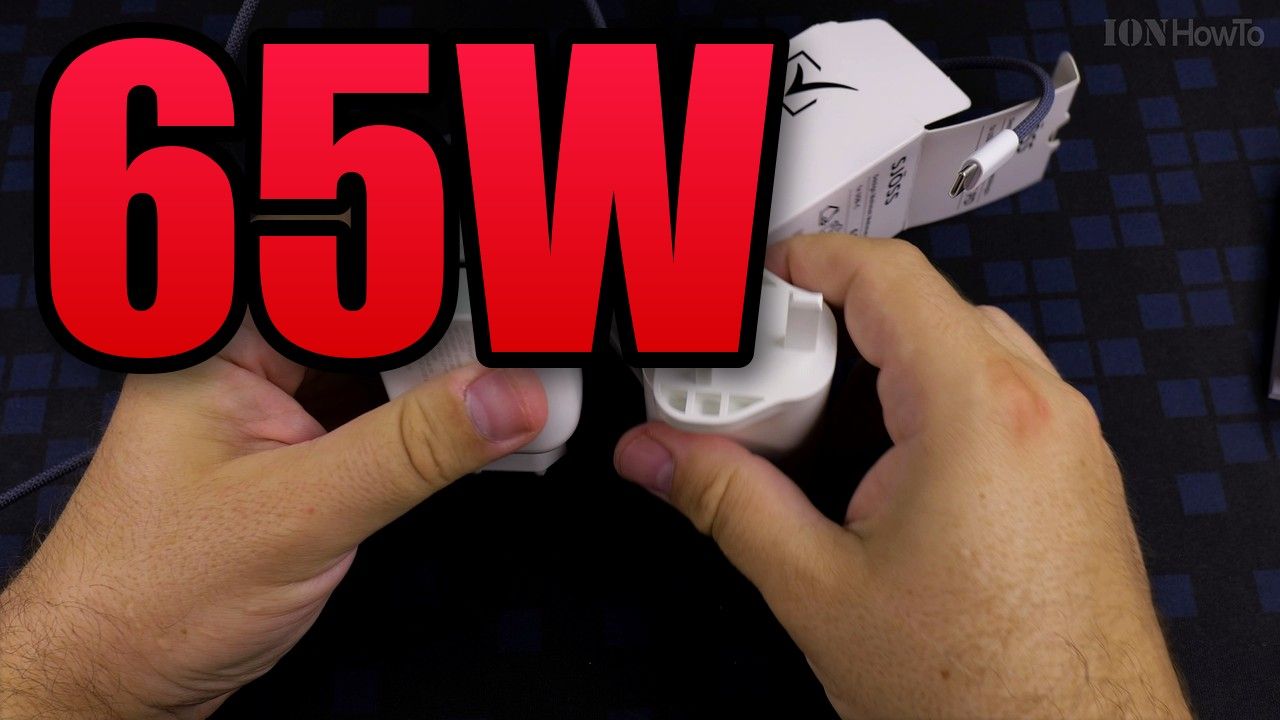
IKEA now sells the Sjoss 65W USB-C charger with a UK plug too. I unbox it, go through the charging modes, compare it with the European version and test it with an iPhone.

Your roadmap
- Pick the plug type for your country
- Check what the charger can deliver
- Use a USB-C to USB-C cable
- Read the manual for the efficiency numbers
- Compare the UK and EU versions
- Plug it in without an adapter
- Test it with a phone
Recommended Amazon Gear and Accessories
Disclosure: This article contains Amazon affiliate links. As an Amazon Associate, I earn from qualifying purchases at no extra cost to you.
- 65W USB-C PD Charger
- USB-C to USB-C Cable 100W
- USB-C to MagSafe 3 Cable
- EU to UK Plug Adapter
- USB-C Power Meter
At a glance
- What it is: the IKEA Sjoss 65W USB-C Power Delivery charger, here with a UK plug.
- Power levels: 15W, 27W, 36W, 45W and 65W, plus PPS and Quick Charge.
- Efficiency: 83% average, 0.08W with nothing connected.
- Compared with the EU version: same specs. Only the plug and the markings are different.
What you need
- The IKEA Sjoss 65W charger.
- A USB-C to USB-C cable rated for 60W or more for laptops.
- A USB-C to MagSafe 3 cable if you charge a newer MacBook Air.
- A UK socket for this version, or a plug adapter for the EU version.
1. Pick the plug type for your country
IKEA first sold the Sjoss 65W with a European plug. Now there is also a UK plug version, and I found it in Cyprus.
Why it matters: With the right plug you do not need an adapter, which is safer and neater.
What you should see: The UK plug pins on the new box.


2. Check what the charger can deliver
The box lists 15W, 27W, 36W, 45W and 65W Power Delivery, plus PPS from 5 to 16 V at 3 A, up to 48W.
Why it matters: These modes let it charge phones, tablets and laptops at the right speed.
What you should see: The table of voltages and currents on the side of the box.


3. Use a USB-C to USB-C cable
The charger only has a USB-C port. If your cable has a USB-A end, it will not fit.
Why it matters: For 65W laptop charging, the cable also needs to be rated for at least 60W.
What you should see: The single USB-C port on the front of the charger.


4. Read the manual for the efficiency numbers
The manual adds two numbers that are not on the box. No-load power is 0.08W, and efficiency is 83% (73% at low load).
Why it matters: A low no-load number means it wastes almost nothing when left in the socket.
What you should see: The efficiency line in the leaflet.


5. Compare the UK and EU versions
Side by side, the two chargers have the same specifications and charging modes. The paint finish and the printed markings are a bit different, and the UK one has UK compliance text.
Why it matters: Both are original IKEA chargers. Choose the one that fits your sockets.
What you should see: The two chargers next to each other.


6. Plug it in without an adapter
With the EU version I had to use an adapter here. The UK version goes straight into the socket, and the safety shutters work properly.
Why it matters: Adapters can sit loose and they skip some of the socket’s safety design.
What you should see: The charger sitting firmly in the UK wall socket.

7. Test it with a phone
I plugged in my iPhone with a USB-C cable and it started charging right away.
Why it matters: The charger and the device agree on the best power level, so a phone will not get the full 65W. A laptop that supports 65W will.
What you should see: The charging icon on the iPhone screen.


If it does not work as expected
- The laptop charges slowly: check that the cable is rated for 60W or 100W.
- Your cable does not fit: this charger is USB-C only. Use a USB-C to USB-C cable.
- The charger gets warm: this is normal at high power. Keep it in open air, not under a pillow.
- The EU plug wobbles in an adapter: get the UK version if you live in a UK-socket country.
Helpful Tips
- A 65W charger is safe for phones. The phone only takes what it needs.
- Keep one good USB-C cable with the charger so you always get full speed.
- The stickers in the box help you tell your charger apart from someone else’s.
Questions people ask
Can the IKEA Sjoss 65W charge a MacBook Air?
Yes, I use it with a USB-C to MagSafe 3 cable.
Is the UK version different from the EU version?
Only the plug and markings. The specs are the same.
Does it support PPS for Samsung phones?
Yes, PPS from 5 to 16 V at up to 3 A.
Does it have a USB-A port?
No, it has one USB-C port only.
Related Guides
- Ikea 30W vs 45W USB-C Fast Charger Sjoss – Ikea 30W vs 45W USB-C Dual Port vs Single Port Fast Charger Sjoss.
- IKEA Rundhult 100W USB-C Fast Charging Cable: Simple Hands-On Guide and Long-Term Review – Learn how to pick the right fast charging cable for your phone, laptop, or tablet.
- IKEA USB-C 100W vs 60W USB Type-C Cable – New IKEA USB-C Cable 100W vs Old 60W USB Type-C Cable.
- iPhone How-To Guides – Browse more tutorials and practical guides in this section.
Leave a Reply Cancel reply